

Picture this: you walk into a kitchen where the cabinetry glows with a soft warmth, under-cabinet lighting spills across the countertops, and a beautiful pendant casts a gentle pool of light over the island. Outside the window, the garden is illuminated just enough to draw your eye outward. The room feels alive. Inviting. Exactly right. You settle in without quite knowing why, but something about the space just puts you at ease.
That feeling doesn't happen by accident. It's the result of intentional, layered lighting design, and after decades of creating spaces for homeowners across the greater Sacramento area, I've come to believe it's one of the most underestimated elements in interior design. Not because homeowners don't care about it, but because its impact is so deeply felt and so rarely seen.
A conversation with a longtime client changed my thinking entirely. I had just completed a set of beautiful built-in cabinets for her, with puck lights planned inside to make the shelving glow. When I mentioned them, she told me simply that she always forgot they were there. She never turned cabinet lights on. From that moment on, I made a commitment: wherever possible, the lighting I design and the experience it creates should work automatically, without anyone having to remember to turn it on.
Here's what I know after years of doing this work: you can design the most beautiful interior imaginable, and if it isn't lit properly, you're only experiencing half of what that space is capable of. Lighting isn't a finishing touch. It's the heartbeat of a home. And when it's done right, every element in the room is elevated, the materials, the finishes, the furniture, all of it. You feel it the moment you walk in.
Have you ever walked into a room and immediately felt at ease, and couldn't quite explain why? Chances are, the lighting had a lot to do with it. When a home is lit with intention, it has a quiet but powerful effect. It settles your nervous system, signals that it's time to unwind, and makes every element in the room feel more alive. It's not dramatic. It's just there, doing its job beautifully.
The impact shows up most clearly when lighting is wrong. A kitchen that's beautifully designed but poorly lit is only half a kitchen. The cabinetry, the countertops, the backsplash, all of it falls flat without light to bring it forward. That's why we incorporate lighting design into the conversation at the very start of every project, coordinating those plans with the licensed contractor and electrician during construction.
You may have heard designers talk about "layering light," but what does that actually look like in practice?
Think of it this way: a well-lit room isn't lit by one source. It's lit by several, each serving a different purpose, all working together to create something that feels complete. In our work, we typically think about three categories of light, and I make sure every space has a thoughtful mix of all of them.
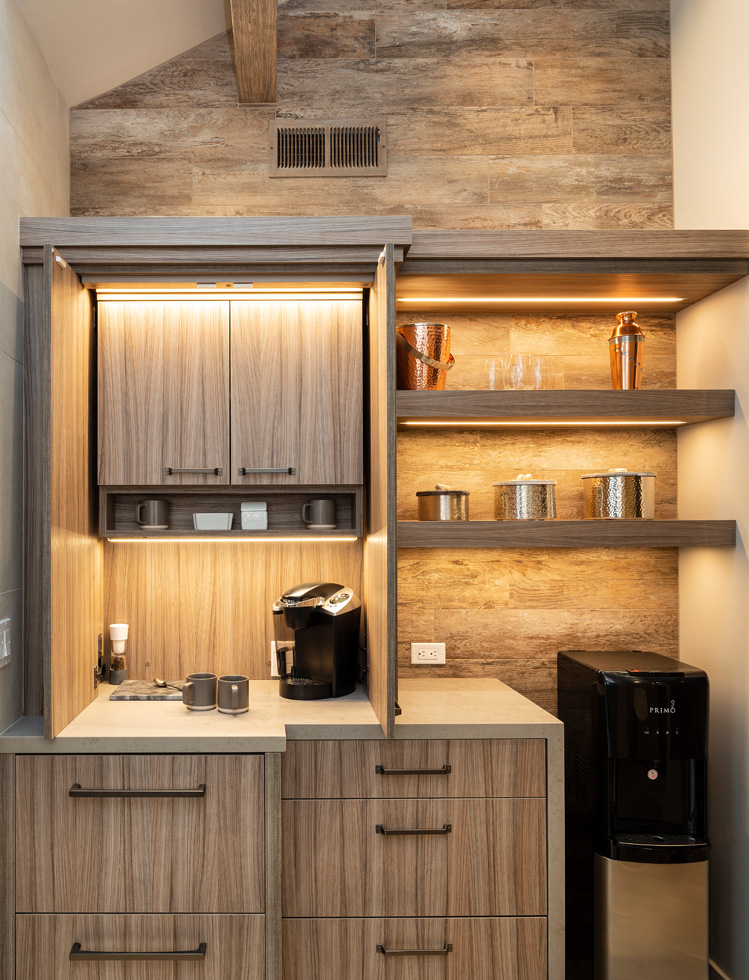
This is your foundation, the general lighting that fills a room and makes it functional. These are your recessed lights and overhead sources. It's what allows you to move through a space safely and comfortably. In kitchens, We’re very deliberate about how we space perimeter lighting, placing fixtures to cover the room evenly so there are no dark corners pulling the eye down.
Task lighting is exactly what it sounds like: light designed to help you do things. In a kitchen, that means brighter, more focused light right where you're chopping, prepping, and cooking. In a bathroom, it means making sure you have the right light for getting ready in the morning. Task lighting is positioned and spaced with real intention. It's not just about brightness; it's about putting the right light in the right place so you're never squinting or straining.
This is where the magic happens. Chandeliers, pendants, under-cabinet lighting, the soft glow of toe-kick lighting at the base of your cabinets, the gentle wash of light inside a display case. These sources do as much for how a room feels as they do for how it functions. The same principle applies to art. If you have a piece you love, it deserves to be lit properly. Good lighting transforms art from something you walk past into something that draws you in.
When all three layers are present and working together, you feel it. That's the goal.
One thing that surprises a lot of homeowners is how closely interior and exterior lighting need to be considered together, especially here in Sacramento and throughout Northern California, where we can enjoy our outdoor spaces for so much of the year.
Here's why it matters: when your interior is beautifully lit but your landscape is dark, the windows in your home become mirrors at night. All you see is your own reflection looking back at you. But when your landscape lighting is balanced with your interior lighting design, those windows open up. You see your garden, your outdoor living space, the warm glow of the world beyond your walls. The experience of your home extends outward, and that changes everything.
For anyone who loves entertaining or simply enjoys sitting outside at the end of the day, this connection between inside and outside is one of the most meaningful things we can design for.
Now we come back to that client who never turned on her cabinet lights.
The solution, and one I now recommend as often as possible, is a smart home lighting control system. The idea is simple: rather than walking around your home flipping individual switches every time you want to change the mood, you create preset scenes that do it all at once. You press one button, and your home transforms. Once these systems are set up, you don't have to think about them. Your lights simply do what you need them to do, when you need them to do it, and the experience of your home shifts effortlessly throughout the day.
In my own studio, I have exactly this kind of system in place. I have an everyday scene for regular working hours, a presentation scene for client meetings, and a party scene for when we're celebrating. Each one adjusts every light in the space to exactly the right level without a second thought. It's one of those things that once you have it, you can't imagine living without it.
In a home, the scenes you create can be as personal as the way you live. Here are a few that make the biggest difference for my clients:
The lights come up bright and energizing, the kind of light that helps you shift into action mode. Homework gets done, dinner gets made, the evening gets moving. It's a small thing that sets the tone for the whole night.
Once dinner is finished and the pace of the evening slows, a simple button press shifts everything. The lights dim, the mood softens, and your home quietly signals that it's time to rest. You didn't do anything. It just happened.
Lighting for a gathering is a little moodier, a little more intimate. Things dim down, the landscape outside comes into view through the windows, and the whole space invites people to settle in and stay awhile. That atmosphere doesn't happen by chance. It's designed.
Some lighting control systems can even be scheduled to adjust on their own throughout the day with no input required. I have motorized shades in my own home programmed to close when the afternoon sun is strongest and open again each morning to bring in daylight. I never touch them. They just work. That's the beauty of designing a home that truly takes care of you.
We hear it often, especially during new builds or larger renovation projects: the budget is stretched, decisions need to be made, and lighting feels like a reasonable place to pull back. We understand the impulse, but we'd gently push back every time.
Here's what we've seen consistently over the years: clients who invest properly in their interior lighting design forget they spent that money. Within a few months of living in the space, all they know is that their home feels incredible. They feel good there. They don't always know why, but we do. Clients who didn't prioritize lighting tend to look back and wish they had. Retrofitting lighting after the fact almost always costs more than doing it right the first time, and the disruption simply isn't worth it. Lighting is one of those investments that pays you back every single day, in the quality of how you feel in your own home. That's not a small thing.
A beautifully designed home should feel beautiful to live in, not just to look at in photos. That's really what layered lighting design is about. It's not a technical exercise. It's about making sure that when you walk through your front door at the end of the day, your home is ready for you. That it greets you the way a home should. That every room feels like exactly what it's supposed to feel like.
The best part? With the right home lighting design and automation in place, you don't have to do a thing. Your home simply responds to your life, shifting, adjusting, and creating the right atmosphere without you ever having to think about it. That's what good design feels like from the inside.
If you're planning a renovation, building a new home in the Sacramento area, or simply wondering why your current space doesn't quite feel the way you hoped it would, lighting is often the answer. And it's something we love helping our clients get right. Reach out to schedule a discovery call, and let's start creating a space that feels as good as it looks.
We know you may still have a few questions before starting your kitchen remodel. Here are answers to some of the most common ones we hear.
Layered lighting uses several light sources in one room, each with its own purpose, so the space feels complete rather than lit from a single point. Interior designer Cathy Tonks of Designs With You in Mind plans three layers into every room she designs. When all three work together, you feel the difference the moment you walk in.
Pathway and perimeter lighting is the foundation: the recessed and overhead light that lets you move through a room comfortably. Task lighting puts focused light where work happens, like the prep area in a kitchen or the mirror in a bathroom. Decorative and ambient lighting, such as pendants, chandeliers, under-cabinet and toe-kick lighting, shapes how the room feels.
Right at the start. Designs With You in Mind brings lighting into the conversation at the beginning of every project, while there is still room in the plan and the budget to do it properly. Planned early, lighting brings every material, finish, and piece of furniture in the room to life.
Balanced lighting lets your home extend beyond its walls after dark. When the inside is lit but the landscape is dark, windows reflect the room back at you. With both planned together, you see through to the garden and outdoor living areas instead. In the greater Sacramento area and Northern California, where outdoor spaces get so much use, Cathy designs the two as one.
A lighting scene is a preset that adjusts every light in a space at once with a single button, through a smart lighting control system. Cathy often designs scenes like “Welcome Home”, with bright, energizing light for busy evenings, “Wind Down”, which dims the house after dinner, and “Entertaining”, a moodier setting that brings the lit garden into view.
Cathy recommends them as often as she can, because they let your lighting work without anyone having to think about it. One button sets every light in the room for the moment. Some systems can also run on a schedule. In Cathy's own home, motorized shades close in the strongest afternoon sun and open again each morning.
Lighting is one investment Cathy encourages clients to protect, because it shapes how you feel in your home every day. The right lighting lets your cabinetry, countertops, and finishes look their best, helps you unwind in the evening, and makes every room feel inviting. Within a few months, most clients forget what they spent and simply know their home feels good.